Why Canada?
What does Canada have to do with genocide?
Because Canada is not a bystander. Canada claims to have an arms embargo on regimes carrying out genocide. It doesn't. Canadian weapons components, F-35 fighter jet parts, explosives, bullets, continue flowing through a legal loophole that routes them through the United States first. Once they cross the border, Canada claims no responsibility for where they go. The bombs dropping on Gaza and elsewhere have Canadian parts in them. Your tax dollars paid for some of what is killing people right now.
The Canadian government knows this. On March 11, 2026, Parliament voted on Bill C-233, the No More Loopholes Act, introduced by NDP MP Jenny Kwan, which would have closed the loophole and required human rights assessments on all military exports. It was voted down 295 to 22. The Carney government killed it.
Canada votes at the United Nations, where its votes carry weight. And Canada maintains full diplomatic relations with genocidal regimes today, relations that signal acceptance, not opposition.
On May 15, 2026, almost 200 former senior Canadian diplomats wrote to Prime Minister Carney urging "robust" sanctions on Israel, citing the blockade of Gaza, the high civilian death toll in Lebanon, and Israel's ongoing destruction of civilian infrastructure. They called for a review of Canada's trade agreement with Israel. Their letter noted that "without robust international sanctions the Israeli government will persist in disregarding international law."
In two separate attacks on unarmed civilian vessels in international waters, Israeli naval commandos kidnapped 428 international citizens from 48 countries. The first attack came on April 29, 2026, off the coast of Crete, where Israeli forces boarded 21 vessels and abducted 181 participants, injuring at least 35 people with rubber bullets and physical violence. The second attack came on May 18–19, 2026, near Cyprus, where Israel seized all remaining vessels of the Global Sumud Flotilla. Survivors reported a coordinated campaign of torture, physical and sexual violence. Prime Minister Carney called Israel's treatment of detained citizens "abominable" and summoned the Israeli ambassador to Ottawa. All 428 were eventually released.
I am a human being who lives on a small island off the coast of British Columbia. I'm not an organization, not a politician, not an activist by training. I'm someone who looks at what is happening and cannot look away. I believe most Canadians are the same, that underneath the noise and the politics and the distance, we are people who care. Who feel. Who know the difference between right and wrong. This campaign is built on that belief.
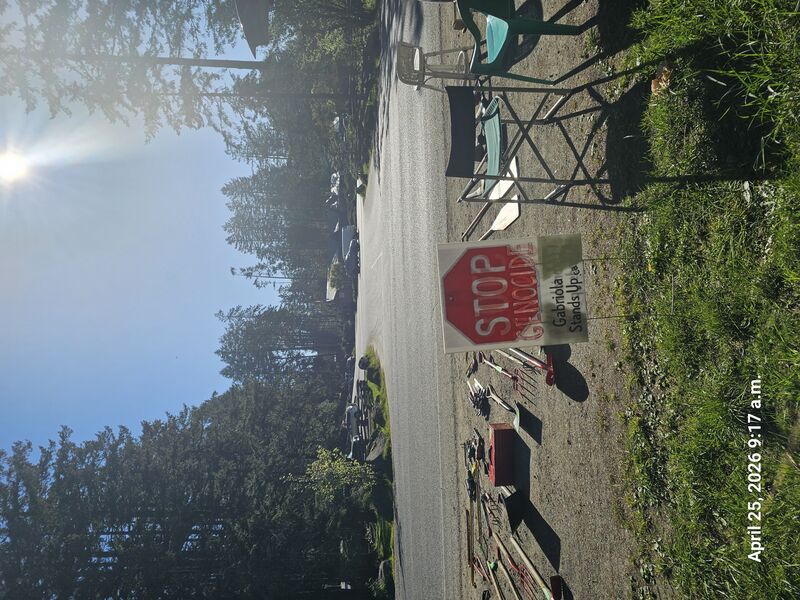
A sign in your yard won't stop a bomb. But silence is also a statement. Communities across Canada putting up Stop Genocide signs says that people here are paying attention, that we are not looking away, and that we expect better from our country.
What is genocide?
Genocide is the deliberate extermination of a people, through mass killing, starvation, displacement, or the systematic destruction of the conditions necessary for survival. It is defined in the 1948 UN Genocide Convention, which Canada has signed, as acts committed with intent to destroy, in whole or in part, a national, ethnic, racial or religious group.
The International Court of Justice has ruled there is a plausible case that genocide is being committed in Gaza. Amnesty International, Human Rights Watch, and dozens of legal scholars have reached the same conclusion. As of June 2026, Genocide Watch lists Gaza, Sudan, the DRC, Myanmar, and Rojava in northern Syria as active Genocide Emergencies.
The following scholars, legal experts, and organizations have all concluded that Israel is committing genocide in Gaza, including prominent Israeli historians and Holocaust scholars:
- The International Association of Genocide Scholars (IAGS), passed a resolution stating Israel's actions in Gaza meet the legal definition of genocide
- Omer Bartov, eminent Israeli-American Holocaust historian, Brown University: "I'm a genocide scholar. I know it when I see it."
- Amos Goldberg, Israeli Holocaust and genocide scholar
- Raz Segal, Israeli historian, Professor of Holocaust and Genocide Studies
- Avi Shlaim, Israeli historian, Emeritus Professor of International Relations, Oxford University
- Lee Mordechai, Israeli professor of history, Hebrew University of Jerusalem
- Maung Zarni, genocide scholar and Nobel Peace Prize nominee
- William Schabas, one of the world's leading legal scholars on genocide
- Francesca Albanese, UN Special Rapporteur: "Gaza Genocide: A Collective Crime"
- Craig Mokhiber, former Director of the NY Office for the UN High Commissioner for Human Rights
- Richard Falk, Chairman of Euro-Med Monitor's Board of Trustees
- Prof. Michael Lynk, former UN Special Rapporteur on Human Rights
- The Lemkin Institute for Genocide Prevention
- UN Independent International Commission of Inquiry on the Occupied Palestinian Territory
- Human rights law clinics at Boston University, Cornell, Yale, and the University of Pretoria
- Jewish Voice for Peace Rabbinic Council
When we say END GENOCIDE, we mean this. Not a metaphor. Not hyperbole. This.
That's why Canada.